
When Continuity Found its voice

Updated: May 28

Echoes of the Pink Amazon Dolphin
In Memory of Marjan Minnesma
27/05/2026
Article By:
A Hummingbird Named Vida

When Lourens de Groot, founder of SELVA–NL, sent word of Marjan Minnesma’s passing, the news travelled from the low skies and canals of the Netherlands toward the great rivers of the Amazon like one more current joining distant worlds through water, memory, and shared responsibility.
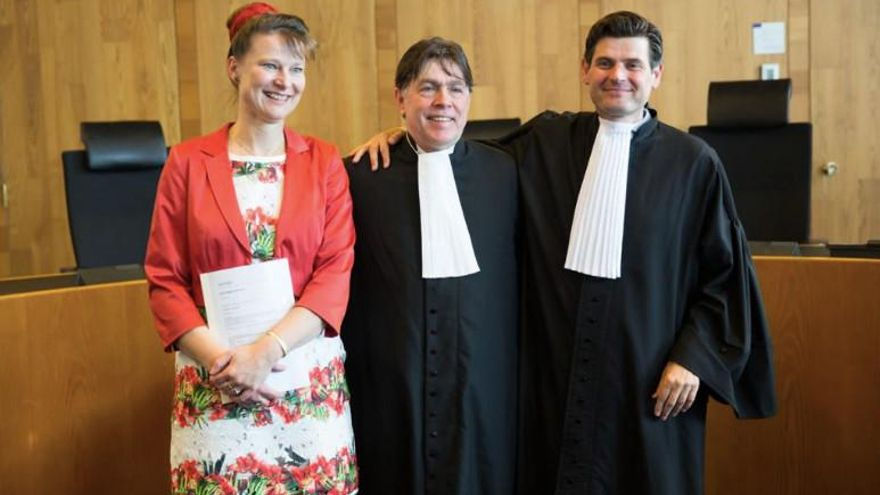
For many years, Minnesma stood among the clearest and most influential environmental voices in Europe, helping transform climate responsibility from political language into legal obligation through the historic Urgenda movement and its unprecedented case against the Dutch State.
Minnesma’s work earned international recognition across the fields of sustainability, climate policy, and environmental leadership. In 2022, she was awarded the prestigious Goldman Environmental Prize, often described as the “Green Nobel Prize,” in recognition of her leadership in the Urgenda case and its global implications for climate accountability. Under her leadership, Urgenda itself became internationally recognised as one of the most influential climate movements of the modern era, inspiring environmental litigation and civic action far beyond the Netherlands.

Through Urgenda, one of Europe’s most influential climate movements, Minnesma helped establish one of the defining legal precedents of the modern environmental era: that governments hold a duty of care not only toward present populations, but toward the environmental continuity upon which future generations depend.
At the heart of the case stood a principle both simple and profound. Scientific knowledge alone was no longer enough. The climate crisis had already moved beyond the realm of uncertainty. Forests, glaciers, rivers, oceans, and seasons themselves had begun responding visibly to the accelerating pressures of industrial civilisation.
The real question was whether political and economic systems still possessed the wisdom and courage to act before the damage became irreversible.
When the Dutch Supreme Court ultimately upheld the Urgenda ruling in 2019, it affirmed something unprecedented in modern environmental history: that governments possess a legal duty to protect their citizens from the foreseeable dangers of climate change.
In doing so, the Court transformed climate responsibility from political preference into an obligation grounded in law, science, and the protection of human life itself.
The atmosphere, for perhaps the first time in history, had entered the courtroom.

Minnesma often insisted that humanity could not solve its crises “with the same thinking that created them.” Beneath the legal arguments and climate negotiations lay a deeper recognition: modern civilisation had increasingly separated economic activity from the living systems upon which all prosperity ultimately depends.
In an unexpected way, the Urgenda decision also echoed another historic legal milestone emerging from the opposite side of the Atlantic: Ecuador’s 2008 Constitution, the first in the world to formally recognise the Rights of Nature.
Though born from different legal traditions and realities, both developments reflected a growing recognition that the ecological foundations sustaining human societies can no longer remain invisible within law, economics, and political decision-making.
And yet, history possesses its own peculiar ironies. Ecuador became the first nation on Earth to constitutionally recognise the Rights of Nature, while successive generations of political leaders continue behaving as though those pages had been written in invisible ink.
Because beneath the policy debates and emissions targets stood a far deeper civilisational question: whether humanity still possessed the capacity to think beyond immediacy itself.
In this, Minnesma’s work carried an unexpected resonance with the great intact forests of the Amazon.
The rainforest exists through rhythms far older than modern economies and political systems. The Amazon lives through the return of rains across centuries, through rivers carrying Andean waters toward the Atlantic, through trees whose silent existence regulates climate, biodiversity, atmospheric stability, and agriculture across entire continents.
At dawn, when mist rises above blackwater tributaries and the first calls of the oropendolas descend through the canopy, the forest reveals another understanding of time — one measured not in electoral cycles or quarterly profits, but in the patient accumulation of life across generations.
Rachel Carson once warned humanity about the heedless pace of man against the deliberate pace of nature. Minnesma belonged to that rare lineage of individuals who understood that the environmental crisis is ultimately not only ecological, but temporal: a rupture in humanity’s relationship with responsibility, foresight, and the future itself.
These questions have increasingly begun moving beyond philosophy and environmental ethics into the fields of economics, law, and ecological valuation.
Recent peer-reviewed work by Giles Jackson, Jens Doedderlein, and Satria Mulyadi, published in the Journal of Applied Business and Economics, helped demonstrate that intact Amazonian forests generate measurable long-term economic value far exceeding the temporary logic of extraction.
Their study on ecosystem services valuation in the Ecuadorian Amazon opened an important pathway toward recognising that intact ecosystems are not passive landscapes awaiting conversion into commodities, but active generators of climatic regulation, hydrological stability, biodiversity, and long-term planetary balance.
From within the Amazon itself, these discussions continue evolving further through the Theory of Intact Ecosystems (TIES), developed in the article Time, Continuity, and the Economic Value of Intact Ecosystems, published on iamselva.org.
TIES advances the growing understanding that humanity’s long-term future depends upon preserving ecological systems capable of sustaining climatic and biological balance across generations.
In many ways, the work of Marjan Minnesma helped illuminate the path toward this emerging understanding, because the defence of nature is ultimately inseparable from the living systems upon which civilisation itself depends.
Far from the political centres of Europe, the Amazon continues offering the world a profound reminder: the future cannot be separated from rivers, forests, rainfall, soil, and the delicate ecological balances accumulated across thousands of years.
In the great forests of the Amazon Basin, where ceibos still rise above the canopy like ancient guardians and pink dolphins surface silently through blackwater currents, the name of Marjan Minnesma now enters that immense geography of memory through which rivers, forests, and human beings continue speaking to one another across generations.
For there are people whose lives eventually become inseparable from the landscapes they struggled to protect.
And long after the conferences, court rulings, political speeches, and anxieties of the present century have faded into silence, rain will continue falling upon the forests of the Earth that Marjan Minnesma helped defend for future generations.
“We cannot solve problems with the same thinking that created them.”— Marjan Minnesma


Comments