

Amazon Medical & Community Services
The future of the Amazon is inseparable from the future of the Indigenous communities whose lives, histories and territories have formed part of it across generations. A living rainforest and healthy, resilient communities belong to the same future.
The expansion of extractive economies has progressively damaged both. Oil development—and increasingly mining—has fragmented ancestral territories, degraded forests and rivers, and weakened the natural economy upon which generations depended for food, water, medicinal plants and much of what everyday life required. As those resources diminish, families are forced to purchase necessities once provided by the rainforest in places where opportunities to earn money remain scarce.
Thus one of the richest natural environments on Earth can become home to extreme material poverty.
It was within this changing Amazon that SELVA began its medical programme in 1992.
Taking Medicine Where It Was Needed
Regular professional healthcare was largely absent from many of the remote Cofán, Siona, Secoya and other Indigenous communities with whom we began working. The response was immediate: bring the medicine to them.
Ecuadorian and international doctors and nurses travelled by river with medicines, diagnostic materials and medical supplies. Consultations took place wherever they could—a community building, an improvised room and, when necessary, a canoe.
Among the gravest medical problems encountered was amoebiasis. Invasive amoebic disease emerged as a major contributor to the extraordinarily high mortality of those years. Caused by the pathogenic protozoan Entamoeba histolytica, severe infection can progress from intestinal disease to destructive colitis and, in extreme cases, perforation, peritonitis, sepsis and death.
Sustained diagnosis, treatment and follow-up became a medical priority. Today, our medical teams consider amoebiasis effectively under control in several of the areas where we work.
An illness that once contributed to taking lives has lost much of its power to do so.
As the programme developed, so did its capacity to reach further into the Amazon. Three purpose-built medical canoes were created as ARA—Amazon River Ambulances—extending regular professional care along the rivers while enabling medical teams to respond directly to serious outbreaks and emergencies. Over the years, these fluvial services have responded to outbreaks of tuberculosis, dengue and malaria, including the potentially lethal Plasmodium falciparum form.


A Clinic in the Forest
The next step was to expand and professionalise that medical capacity on land. SELVA established a permanent clinic on the Aguarico Amazon Reserve for Peace, providing the hygiene, privacy, equipment and clinical conditions needed to extend the programme from primary care to more comprehensive examinations, more complex medical interventions and sustained professional attention.
The clinic and the Amazon River Ambulances became complementary parts of the same medical programme: professional care with a permanent home in the rainforest, and the capacity to travel wherever illness, emergency or epidemic demanded.


Mothers, Children and a New Generation
In 2012, we developed specialised prenatal and postnatal care.
Pregnancy, childbirth and the neonatal period are among the most physiologically vulnerable stages of human life. Where adequate nutrition, professional monitoring and emergency care are difficult to obtain, otherwise manageable complications can threaten both mother and child.
The wider transformation can now be seen in the communities themselves.
Among the Cofán of Pisurí, Dureno and Sinangoe, the Siona of the Cuyabeno and the Secoya of Remolino Grande—peoples once confronted by devastating levels of mortality—live births now outnumber deaths.
There are many ways of measuring a medical programme.
Few matter more than a new generation growing where one was once disappearing.


When the Forest Can No Longer Feed a Family
Food assistance grew from the same changing reality.
For the people living within it, an intact rainforest is also an immense biological economy. Rivers, wildlife, forests and cultivated areas provide nutrition whose value rarely appears in conventional measures of household income.
When that ecological economy is diminished, hunger can enter through the space it leaves behind.
The consequences are biological as well as economic. Adequate nutrition supports immune function, childhood growth and cognitive development, pregnancy, lactation and recovery from illness. Food insecurity can magnify disease precisely among those least able to withstand it.
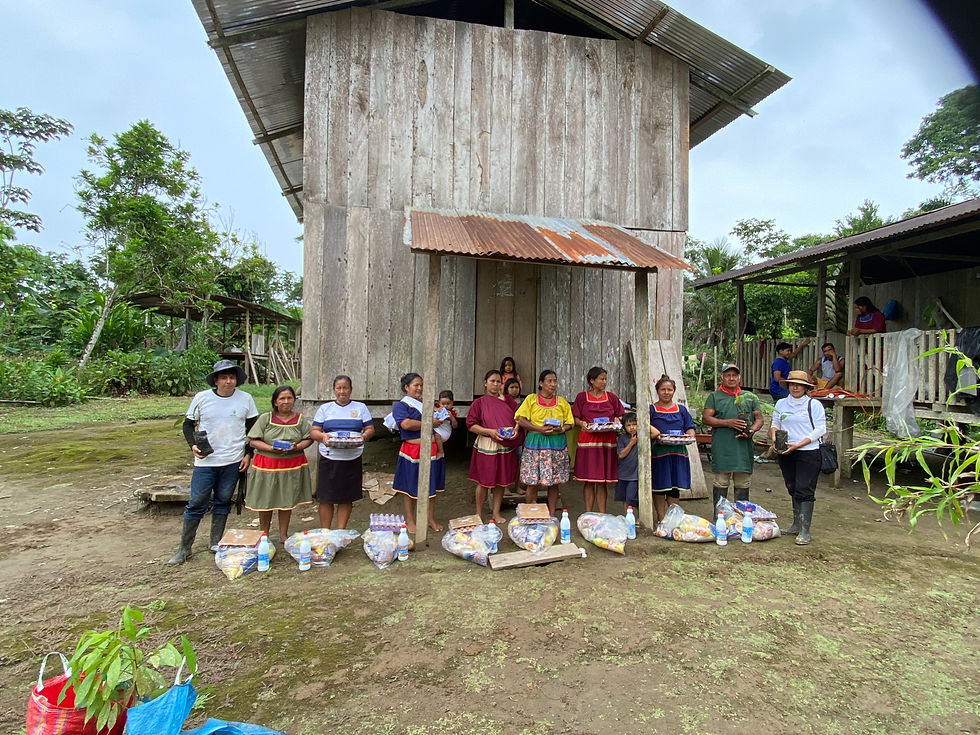
We provide essential food assistance when extreme poverty, environmental damage or emergency conditions place adequate nutrition beyond the reach of families with whom we work.
Medicine and nutrition converge upon the same purpose: protecting the human capacity to live, develop and recover.


When Ecuador’s Health Crisis Reaches the Amazon
Ecuador’s public-health crisis has given this programme a new urgency. For 2026, the Ministry of Health estimated that approximately USD 687 million would be required for medicines and medical devices. The national budget provided USD 300.4 million—less than half the estimated requirement—while public hospitals continued to report serious shortages.
Increasingly, patients and their families must obtain privately what the public system cannot provide. National household data show that 57.78% of household health expenditure in Ecuador already goes to medicines, with rural families carrying a proportionately heavier burden.
In the Amazon, that transfer has particularly severe consequences. Many of the Indigenous families with whom we work live in extreme poverty, hours by river from hospitals and pharmacies, and cannot afford either the medicines they need or the journey required to obtain them. A medicine may exist and yet remain, in every practical sense, beyond their reach.
Under these conditions, continuing SELVA’s medical programme is critical. The Aguarico clinic and the Amazon River Ambulances help keep professional care, medicines and maternal support within reach of communities for whom the alternatives are becoming more distant, less reliable and less affordable.
Help Protect Life
The results of this work can be found not in promises, but in lives: diseases that once contributed to devastating mortality have been brought under control; mothers and newborn children receive specialised care; and in communities where populations were once disappearing, births now outnumber deaths.
Today, that work continues as extractive pressure, extreme poverty and the deterioration of public healthcare make reliable medical attention and adequate nutrition increasingly difficult for many Amazon families to obtain.
Your support keeps that work alive. It helps sustain the Aguarico clinic and the Amazon River Ambulances; provide medicines and professional medical care; protect mothers and newborn children; respond wherever illness, emergency or epidemic demands; and provide essential food when poverty or environmental crisis leaves families without enough.
It also strengthens something less easily measured, but equally important: the ability of Indigenous communities to remain healthy, independent and able to determine the future of their own territories.
If the Amazon matters to you, the people who live within it must matter too.
The rainforest needs them strong.
They need the rainforest alive.
And we all need both—for the climate we share, the waters that connect us, and a living inheritance that belongs not only to the Amazon, but to the world.
Help us protect both.
