
Captain Paul Watson Returns


ECHOES OF THE AMAZON PINK DOLPHIN
16/0/2026
The Whale, the Dolphin and the Conscience of Humanity
By

Operation 86 matters for more than what it achieved in Iceland. After everything Paul Watson has endured, he is once again an active force within the environmental movement.
After years of pursuit by Japan and five months of imprisonment in Greenland, Watson also endured a bitterly contested struggle for control of Sea Shepherd—the organisation he created in 1977 and shaped, in name, philosophy and action, for more than four decades.

The rupture unfolded across Sea Shepherd’s divided international structure. In the United States, control passed to multimillionaire property developer Pritam Singh. At Sea Shepherd Global, Watson was removed under the leadership of Alex Cornelissen, the Dutchman who had joined one of Sea Shepherd's ships as a cook and whose rise to officer, captain and executive director, Watson had fostered.
Under Singh and Cornelissen, Sea Shepherd moved away from the independent direct action for whales, dolphins and other threatened marine life that had made it a moral force. Its centre of gravity shifted towards partnerships with governments, state-supported patrols, research programmes and institutional cooperation.
Sea Shepherd had been born because governments were not protecting the whales. To place its future increasingly within those same systems was therefore more than a change of method. It was a rupture with Watson’s founding conviction that an environmental movement must remain free to confront the authorities and industries responsible—directly or through permission, compromise and failure to act—for the destruction it exists to prevent.
In Shakespeare, Caesar understands the depth of the betrayal only when he recognises Brutus among the knives: Et tu, Brute? Watson’s Ides of March arrived rather more prosaically, by email. The message informing him that he had been removed from Sea Shepherd Global came from Cornelissen himself.
Sea Shepherd retained its name, its fleet and the legend built over more than four decades. Watson had been more than its founder; he was the animating force that gave the movement its identity, its defiance and its moral purpose. Yet he alone was expected to disappear, as though the institution might erase the source of its own character while continuing to inherit its history. It was, one might say, a curious form of succession.
Watson might reasonably have withdrawn. Instead, at seventy-five, he began again through the Captain Paul Watson Foundation.
Operation 86 has shown that his capacity to influence events remains undiminished. The Bandero spent more than a month confronting Iceland’s commercial fin-whaling fleet before being pursued, boarded and detained. Its 21 crew members were deported, yet no criminal charges were filed against the vessel or its crew.
The Icelandic Transport Authority has now released the Bandero from detention following the rectification of the stated deficiencies. The ship nevertheless remains held under a separate civil action brought by whaling magnate Kristján Loftsson, whose fleet was the object of the campaign. The hearing is scheduled for December, after the whaling season has ended.
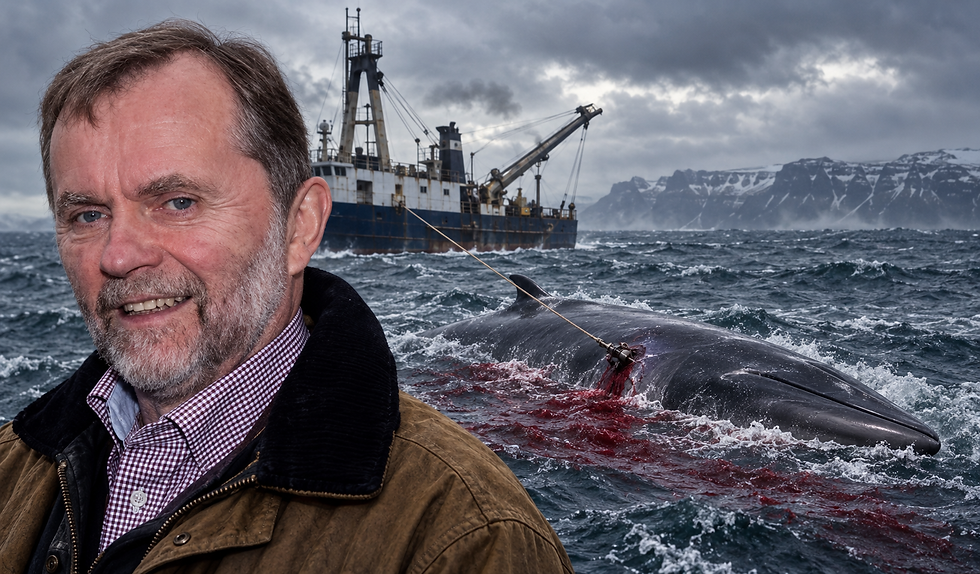
Yet Operation 86 worked. Whales that might otherwise have been killed remain alive. It reminds the environmental movement that there are moments when witnessing destruction is no longer sufficient and someone must be prepared to stand between the harpoon and the whale.
Watson is not commemorating his past. He is acting upon the convictions that defined it.
For SELVA, this carries a quiet historical resonance. Our relationship with Watson reaches back many years and has included a shared concern for whales, dolphins, shark finning and the protection of marine and Amazonian life. In 2007, that common purpose extended to plans for the protection of Amazon pink dolphins and manatees. The connection requires no embellishment: the defence of cetaceans crosses oceans, rivers and institutions.
Today, Watson’s Foundation confronts the killing of vulnerable fin whales in the North Atlantic, while SELVA faces an environmental emergency unfolding through the waters of the Cuyabeno. Produced waters from the failed reinjection system associated with Petroecuador’s Well CUY-04RW have entered an exceptional system of rivers, lagoons, wetlands and flooded rainforest.
As the contamination advanced, the Amazon pink river dolphin entered the record of the dead. No one can yet say how many animals have been poisoned, weakened or lost across that vast aquatic world.
This cannot be dismissed as incidental or collateral loss. The Amazon pink river dolphin is an Endangered species. Every disappearance is the loss of an intelligent and socially connected life whose absence may continue to be felt within its family group.
Whales and dolphins possess extraordinarily complex brains. They remember, learn, recognise one another and maintain enduring social relationships. They communicate through calls, whistles, clicks and song. Some whales carry elaborate songs across immense distances; dolphins use distinctive sounds through which individuals recognise and call to one another. These are voices within societies that humanity has only begun to understand.
Into the body of one of these gentle giants, the harpoon drives an explosive charge. The whale bleeds, struggles and tries desperately to escape, yet death can take hours. Its developed brain and nervous system register the pain and terror. An animal that offered us no threat dies because its body has been assigned a commercial value. What official language calls a harvest remains, for the whale, an atrocity.

Far from the North Atlantic, death reaches the Amazon pink dolphin by another route.
There is no harpoon in the Cuyabeno. The poison enters invisibly—through contaminated prey, through the mouth and through contact with the water. Petroleum compounds attack the lungs, nervous system, liver and blood. The dolphin becomes weak and disoriented, struggling to breathe, to feed and to remain with its family. Its body begins to fail while the instinct to reach the surface remains. Each ascent becomes more desperate until, finally, it can no longer reach the air.
Somewhere in the flooded rainforest, an Amazon pink dolphin rises and disappears beneath the water. Its family continues calling through the darkness, searching for a voice they have known all their lives. But the river has taken that voice and carries only the silence downstream, beneath a sky that has witnessed everything and changed nothing.
In the North Atlantic, the whale bleeds for hours around the iron buried within its body. In the Cuyabeno, the dolphin suffocates within the poisoned water that was once its home. These peaceful beings had done us no harm. Their only misfortune was to inhabit waters to which human greed had assigned another purpose.
We call ourselves civilised. Yet we permit intelligent and sentient beings to bleed, suffocate and die in terror, and then conceal their suffering beneath words such as harvest, production and development. There is no civilisation in this—only the ancient barbarism of power exercised against lives unable to defend themselves.
The whale and the dolphin ask the same question from different waters: whether humanity is still capable of recognising pain beyond its own. The evidence, one must admit, is not altogether reassuring. We live in an age when genocide can unfold before our eyes almost daily—translated into figures, briefings and fleeting images—while ordinary life continues with remarkably little disturbance.
If we can grow accustomed to the suffering of our own kind, it may be optimistic to expect the bleeding whale or the poisoned dolphin to trouble our conscience for very long. That, of course, is precisely why their suffering must not be allowed to disappear.
Paul Watson’s answer has been to return. SELVA’s answer is to survive & continue.
For the ocean. For the rainforest. For the life that depends upon both.


Comments