
El Niño Finds a Wounded Amazon

Updated: Aug 24

ECHOES OF THE AMAZON PINK DOLPHIN
21/08/2026
When the Amazon Rainforest Begins to Fear the Dry Season
By

A rainforest should not fear the dry season.
Its ceibos were raised by rain. Beneath them, mahogany, canelo and great-rooted higuerones rise through layers of palms, lianas and shadow. Macaws carry colour across the canopy; monkeys disperse seeds through the branches; pink river dolphins surface beneath skies reflected in waters that began their journey among distant mountains. The rainforest breathes through all of them, while its leaves return water to the sky in quantities capable of cooling and irrigating a continent.
Through wet seasons and dry, the Amazon has renewed this immense circulation: river becoming cloud, cloud becoming rain, rain entering root and soil before beginning its journey once again. Yet a powerful El Niño is approaching an Amazon already wounded by human hands. The rainforest now nears the end of the dry season as though approaching a fire.
In an article published on 14 August 2026, The Guardian warned that El Niño may reach its peak at the worst possible moment for the Amazon: between October and December, when rivers are lowest and vegetation is driest. Scientists fear that an exceptionally powerful event could delay the rains, deepen the drought and expose an already damaged rainforest to fires of unprecedented severity. El Niño, however, is not the sole author of this danger. It is a natural phenomenon; the condition of the Amazon it is about to enter is not.
The danger lies not only in the strength of the coming event, but in what has happened to the rainforest since the last one. The Amazon has not fully recovered from the El Niño of 2023–2024, when rivers fell to record lows, communities were isolated, fires spread through drought-stricken vegetation and extraordinary numbers of fish and river dolphins died as shallow waters became lethally warm. Now the heat may return to a rainforest in which approximately one-third has already been degraded by agriculture, logging, mining, fire and human-driven climate disruption.
Degradation is more elusive than destruction. A rainforest may remain alive when seen from above and yet be losing the conditions that once sustained it. Where roads and logging break the canopy, sunlight and wind penetrate the interior; humidity falls, temperatures rise and leaf litter dries. These disturbed margins become more vulnerable to fire and, once burned, hotter and drier still, making another blaze more likely and more destructive. A living system that evolved without recurrent fire can thus be drawn into a cycle against which many of its trees possess few defences.
Conversion to pasture and cropland extends the injury. Shade disappears, soils lie bare and the intricate movement of moisture between root, trunk, leaf and atmosphere begins to falter. What remains must endure a climate increasingly different from the one in which it evolved.
Oilfields fracture the landscape with roads, pipelines and settlements. Mining strips vegetation, burdens rivers with sediment and, where mercury is used in gold extraction, contaminates aquatic food webs. Waterways may continue to flow, but their chemistry, temperature and suspended material can change—and with them the conditions governing life downstream.
One intrusion prepares the way for another. An access road can admit logging crews, miners and settlers; settlement brings further loss; and an injured rainforest becomes easier to burn, occupy and divide. What appears on a map as a narrow line can alter temperature, moisture and life far beyond its visible boundaries.
Fossil-fuel combustion exerts a wider pressure, continuing to raise global temperatures and intensify the drought that the approaching event may bring. The natural oscillation will arrive, but it will encounter an Amazon already disturbed. El Niño did not create these wounds; it will reveal how deep they have become.

When the Forest Can No Longer Cool Itself
The Amazon cools itself through evapotranspiration. Water drawn through roots and released by leaves consumes solar energy as it becomes vapour, cooling the vegetation and the air around it. Across a basin of almost unimaginable scale, countless exchanges combine into one of the planet’s great biological systems for regulating heat.
Much of that vapour later returns as rain. Some travels westwards and southwards in immense aerial currents—often called flying rivers—which contribute to precipitation across South America, including regions beyond the Amazon Basin. Farms, reservoirs and cities have developed beneath rainfall patterns sustained in part by this movement of moisture.
Degradation weakens this circulation. Tree loss reduces the living surface through which water can rise; exposed ground absorbs additional heat; and drought-stricken trees close the microscopic pores in their leaves to conserve moisture, further diminishing their capacity to cool the surrounding air. The same injury reaches the carbon held within trees, roots and soils. When vegetation dies, decays or burns, part of that accumulated carbon returns to the atmosphere precisely when humanity most needs living forests to restrain global warming.
An injured Amazon does not by itself explain every fire, drought or heatwave on another continent. These events arise within a global climate destabilised principally by fossil-fuel emissions and compounded by the destruction of natural systems. But no loss of rainforest is merely local. Each diminishes the planet’s capacity to store carbon, circulate moisture and moderate rising temperatures. A wound opened beside an
Amazon river can rise invisibly into the atmosphere and begin to travel.

The Warning Has Reached Us
That scientific distinction does not make the warning less immediate. Across Europe, summer has acquired the taste of smoke. Windows remain closed while heat gathers inside homes. The afternoon sun appears through a dulled or orange sky; ash settles upon gardens, streets and children’s playgrounds. Rivers withdraw from their banks, fields harden, and those confronting wildfires enter landscapes where a change in the wind can overtake a human being.
The old assurances of the European summer are becoming less reliable. Rain does not arrive when crops require it. Riverboats sit lower—or cease moving altogether. Gardens turn brittle beneath watering restrictions. In cities built to retain warmth through winter, stone, brick and glass absorb the afternoon heat and return it after sunset.
Night offers no certain relief. Bedrooms preserve the temperature of the day; fans move warm air from one side of the room to the other; sleep breaks into intervals. The elderly, the ill and those living beneath poorly insulated roofs carry the greatest burden. The human body understands—and remembers—what political language attempts to conceal: there comes a temperature at which heat is no longer weather, but danger.
By early August 2026, the word record had begun to lose its power to surprise. Western Europe had endured the hottest June and June–July period ever measured; across several countries, daily maximum and even all-time temperature records had been broken. Each new bulletin confirmed what the body already knew. More than half a million hectares had burned within the European Union—well above the area recorded during the corresponding period of 2025, which ultimately became the EU’s worst fire season on record. At the same time, drought placed rivers, crops, transport and energy systems under increasing pressure. Half of the European Union and the United Kingdom was experiencing drought at some level of intensity by late July.
Names survived where living landscapes had not. In Spain, fire reached the ecological heart of the Sierra Norte de Guadalajara Natural Park.

In France, flames moved through the maritime-pine forests of Gironde and Landes, from Saumos towards Lacanau, Le Porge and Cap-Ferret.

These were not anonymous hectares. They were places remembered for their shade and beauty, for familiar paths, the scent of pine after rain and the song of a nightingale after dusk. When the flames passed, blackened trunks stood beneath smoke-darkened skies and the familiar music of the landscape fell silent.
Across the Atlantic, the destabilised climate assumes other forms. During July, smoke from Canadian wildfires travelled thousands of miles across the United States, bringing dangerously poor air quality to communities far from the flames. It required no passport and observed no frontier; it merely followed the atmosphere southwards. Satellite images made visible what human lungs had already begun to understand.
Nor does the disruption end in the air. Drought reaches reservoirs and harvests; low water interrupts transport and energy production; fire removes vegetation that once restrained erosion and floodwater. An event beginning in a forest or river enters food prices, electricity supplies, public health and household life somewhere else.
The connection with the Amazon is not a straight line upon a map. It is a cycle moving through water, carbon and heat. Every day, Amazonian trees release approximately 20 billion tonnes of water into the atmosphere—more than the Amazon River carries daily into the Atlantic. Their moisture sustains rainfall across much of South America, while their trunks, roots and soils hold between 150 and 200 billion tonnes of carbon that would otherwise intensify global warming. A living system operating on that scale is not climatically remote from any continent.
The fires of Sierra Norte, Gironde and Landes belong to the same planetary warning. Fossil-fuel emissions raise the temperatures that dry European forests and enter the Amazonian dry season. When Amazon trees are felled, degraded or burned, stored carbon returns to the atmosphere and one of the Earth’s great systems for circulating water and moderating heat is diminished. The injury moves in both directions: a warming world wounds the Amazon, and a wounded Amazon leaves the world less able to resist the warming.
For generations, the Amazon could be imagined as a remote immensity—admired in documentaries, defended in speeches and forgotten when economic interests intervened. That comfortable separation has become increasingly difficult to maintain. Once heat has entered the home, smoke the lungs and silence the places people loved, the fate of the Amazon ceases to be someone else’s concern. The person who remembers European parks losing their shade, familiar forests burning and birds falling silent is not being asked to protect a distant rainforest out of charity.
When the next heat record falls, when smoke returns or another remembered landscape burns, the standing Amazon should come to mind. Its survival forms part of the climatic defence of every person living beneath the same atmosphere. The relationship is one of shared dependence; and if the danger is now visible, so too are the decisions that have allowed it to grow.
The Bill Arrives Either Way
After a forest burns, money arrives with remarkable punctuality. It pays for aircraft, evacuations, hospitals, compensation, reconstruction, reservoirs, cooling systems and attempts to return trees to soil from which shade has vanished.
Before the fire, however, protecting the forest is frequently described as too expensive. This is a curious economy: the living forest provides environmental services on a continental scale—cooling the air, regulating water, protecting soils, sustaining pollination, sheltering biological diversity and holding carbon within trees and roots—without sending an invoice; destruction presents its account immediately.
Even when that account is paid, much of what disappeared cannot simply be purchased back. A plantation can be established, but it cannot reproduce centuries of ecological relationships by the end of a government programme. Rivers do not recover because funds have been released, birds do not return upon receipt of the correct authorisation, and an extinct species remains unimpressed by the size of the restoration budget. Money can repair roads, rebuild houses and compensate part of a human loss. It cannot instruct time to begin again.
The choice is therefore not between paying and paying nothing. The bill arrives either way. The real choice is whether to invest before destruction—in protection, prevention and the continued work of living systems—or to pay afterwards for emergency, reconstruction and an incomplete imitation of what once existed.
The Amazon stands at the centre of that choice. The Guardian’s warning that a powerful El Niño may enter an already weakened Amazon should be particularly disturbing after the recent experience of record heat, drought, smoke and fire. It describes a natural climate event approaching a rainforest whose capacity to resist it—and to continue moderating a warming world—has already been diminished by human action. Humanity can invest in keeping its forests alive and their environmental services functioning, or allow those systems to deteriorate and inherit a hotter, drier and more expensive world. Protecting the Amazon is not the costly alternative to development. It is the less costly alternative to destruction. Economists may wish to debate the precise price. Fire, drought and a sleepless human body have already begun to submit their estimates.
Trump at the Podium
One might imagine that the accumulating evidence of climatic disruption would make climate denial politically untenable. Instead, it has become an instrument of power and a political licence for extractivism: expanding oil, gas and mining is presented as an expression of sovereignty, while ecological limits are treated as weakness. We call this new extractive nationalism. It is not confined to the traditional Left or Right, but can be adopted across the political spectrum.

On 23 September 2025, Donald Trump stood before the United Nations General Assembly and described climate change as “the greatest con job ever perpetrated on the world”. He called the carbon footprint a hoax and warned governments that unless they abandoned what he termed the “green energy scam”, their countries would fail. Behind him stood the emblem of an institution created to confront dangers that no nation can resolve alone. Outside, the atmosphere continued its work without requesting permission to disagree. Climate change, apparently, had failed to understand that it was a confidence trick.
The question facing the rainforest therefore extends beyond what the coming El Niño may do: what political doctrine has made destruction appear not merely acceptable, but desirable?
Traditional resource nationalism asserted a state’s authority over natural wealth within its own borders. The new extractive nationalism does something different. It invokes the nation while serving an economy whose corporations, investors, supply chains and territorial ambitions cross every frontier. It is nationalist in language, but international in appetite. Oil, gas, minerals, forests and transport routes are recast as instruments of geopolitical power, while any restraint upon their exploitation is portrayed as an attack upon prosperity, sovereignty or freedom.
This politics has three recognisable habits. It denies or diminishes ecological limits; converts environmental protection into economic sabotage; and treats strategic control over territory and resources as evidence of national strength. Climate denial is therefore not an eccentric ornament attached to it. It is permission. Once the emergency has been declared fraudulent, regulation can be described as obstruction, Indigenous consent as an inconvenience and protected territories as assets left needlessly idle. Nature, having neglected to issue a quarterly dividend, may then be accused of standing in the way of progress.
The promised benefits belong to the present. The damage is assigned to communities with less political power, or to generations not yet available for consultation. New extractive nationalism does not merely defend a country’s right to use its resources. It joins political identity, corporate extraction and geopolitical ambition in a common refusal of ecological restraint. Some call this sovereignty. Others call it development. The rainforest, which has heard both words before, receives the excavators just the same.
The Movement Travels South
Trump’s words did not remain inside the United Nations. They travelled south, sometimes repeated as doctrine and more often translated into drilling rights, mining concessions and weakened environmental law.

Javier Milei supplied the clearest echo. Argentina’s president has rejected the scientific consensus on human-caused climate change while placing petroleum, gas and mining at the centre of his economic project. In April 2026, Argentina’s Congress approved his government’s reform weakening protections for glaciers and surrounding periglacial areas, opening water-bearing landscapes of the Andes more widely to copper, gold and silver extraction. In Patagonia, Vaca Muerta continues to be promoted as a national promise, its wells multiplying beneath a climate the president prefers not to recognise. The glaciers have continued to melt without awaiting the outcome of the discussion.
Elsewhere, the contradiction is more subtle. A government need not call climate change a hoax if forests, rivers and protected territories are required to yield whenever they obstruct petroleum or minerals.
Brazil demonstrates why this distinction matters. Under Luiz Inácio Lula da Silva, Amazon deforestation fell dramatically, Indigenous rights returned to national policy and climate science recovered the respect denied to it during the Bolsonaro years. These are genuine achievements. Yet Lula’s government also authorised exploratory drilling in the Foz do Amazonas Basin, where Petrobras has detected hydrocarbons beneath waters almost 2,900 metres deep off Amapá. Lula called the discovery a possible “passport to Brazil’s future”.

The proposed logic is that petroleum revenues will help finance the transition away from petroleum. If accepted, any extractive state may open one more oilfield, mine or industrial frontier by promising that its proceeds will eventually support a less extractive future. Ecological restraint becomes something to be purchased later with income from the activity it was intended to restrain. A transition that requires new oilfields whenever it needs money is not yet a transition. It is extractivism acquiring a greener vocabulary.
The emerging alignment therefore accommodates both denial and contradiction. Some governments reject the climate emergency; others acknowledge it while expanding the activities that intensify it. They require no common manifesto. It is enough that extraction prevails whenever nature attempts to impose a limit.

In March 2026, Trump gathered twelve Latin American and Caribbean leaders at the inaugural Shield of the Americas summit. Its declared purpose was to confront cartels and transnational crime through intelligence sharing, military cooperation and direct force. The meeting took place at Trump National Doral, the president’s own golf resort in Florida. Even hemispheric security, it seemed, could be reorganised without requiring the family business to lose a booking.
Doral did not need to place climate denial formally upon its agenda. Security, foreign influence and strategic resources were already entering the same political frame. Oil, gas, gold and critical minerals had moved beyond commerce into the language of sovereignty and hemispheric control. Military cooperation may protect communities and restrain criminal economies. It may also determine who enters a territory, which activity is prosecuted and which proceeds beneath a government licence. Governments holding both the weapons and the concessions acquire considerable freedom to decide where criminality ends and development begins.

Venezuela had already revealed how quickly these purposes could converge. In January 2026, United States forces captured Nicolás Maduro and Cilia Flores in Caracas and carried them to New York to face narcotics and terrorism-related charges.
To condemn what followed is not to defend Maduro. His authoritarian government, its repression and corruption form part of Venezuela’s tragedy; but they do not transform foreign military intervention into democratic principle. The operation raised serious questions under the United Nations Charter’s prohibition against the use of force and the inter-American principles of sovereignty and non-intervention.
Trump’s subsequent publication on Truth Social of an image showing Maduro blindfolded and restrained also turned a detainee awaiting trial into political spectacle—an uncomfortable companion to the dignity and presumption of innocence protected by international human-rights law. Trump then announced that the United States would oversee Venezuela’s transition and turned almost immediately to the country’s immense petroleum reserves.
The war against drugs had arrived accompanied by an oil policy.
Colombia offered a different variation. Its newly elected, Trump-endorsed president, Abelardo de la Espriella, entered office promising an uncompromising campaign against narcotics and armed organisations while advocating renewed oil and gas exploration, fracking and accelerated mining. Yet the reputation and fortune that carried him into politics had been built substantially by representing figures drawn from the very world he now promised to confront.
Among his former clients was David Murcia Guzmán, creator of the collapsed DMG financial empire, who was convicted of money laundering and unlawfully receiving money from hundreds of thousands of investors. De la Espriella also represented Alex Saab, the businessman later indicted in the United States on money-laundering charges and widely described as a financial operator for Nicolás Maduro’s government. He had additionally maintained a longstanding association with Salvatore Mancuso, a former commander of the United Self-Defence Forces of Colombia who pleaded guilty in the United States to an international cocaine conspiracy; the United States Department of Justice stated that Mancuso directed the manufacture and movement of more than 100,000 kilograms of cocaine.

Those associations did not impede De la Espriella’s ascent; they formed part of the lucrative legal career that made him a millionaire and supplied much of the notoriety upon which his political career was built. Having prospered through professional proximity to narcotraffickers, convicted money launderers and paramilitary power, he presented himself to the electorate as the man uniquely qualified to eradicate them. It was rather like appointing Dracula to manage the blood bank and congratulating oneself upon having recruited the candidate with the most relevant experience.
The comedy might have remained harmless had De la Espriella not also promised to revive fracking, accelerate mining and reopen the petroleum frontier in a country containing part of the Amazon Basin. Militarised security, political power and expanding extraction were once again being placed within the same governing project.
This would be extraordinary enough if military authority and extractive ambition remained above the landscape. They do not. Across the continent, territories in which armed groups, illegal miners and narcotics routes converge frequently overlap with forests containing petroleum, gold and critical minerals. Roads constructed for security can open the way to settlement, drilling and mining. In the Amazon, the distinction between controlling a territory and opening it may decide whether a forest remains standing.

Among the presidents seated at Doral was Daniel Noboa. Four months earlier, he had asked Ecuadorians to remove the constitutional prohibition on foreign military bases. Almost two-thirds rejected the proposal. The result did not end Ecuador’s deepening military cooperation with the United States and other allied governments. These arrangements did not formally establish a foreign base, but they expanded international security involvement after voters had refused to remove the prohibition. The electorate had rejected bases; military cooperation discovered another vocabulary.
At the same time, Noboa’s government reopened Ecuador’s mining cadastre after seven years. In Block 57, Shushufindi–Libertador, Petroecuador announced a project involving hydraulic fracturing with the Chinese contractor CCDC. Farther south, satellite monitoring found that the area affected by mining in Morona Santiago had doubled between 2020 and 2024. These were not isolated administrative decisions. Together they extended the extractive frontier across territories whose forests and rivers form part of the Amazon’s capacity to regulate water, hold carbon and resist the approaching dry season.
The connection with Trump’s declaration is therefore not rhetorical. Denial at the podium creates political permission; permission becomes policy; policy becomes a road, a concession, a fractured geological formation or a forest opened to mining. The journey from speech to landscape may pass through ministries, contracts and military agreements, but it ends in soil and water. From the United Nations to Doral and then to Quito, the direction was becoming clear.
In Ecuador, however, this political doctrine encountered an unusual constitutional inconvenience.
Nature possessed rights.
When Nature Lost Its Ministry

In 2008, Ecuador became the first country to recognise the rights of Nature within a national constitution. Article 71 declared that Nature—or Pacha Mama—possessed the right to the maintenance and regeneration of its life cycles, structure, functions and evolutionary processes. Article 72 established its right to restoration. Article 73 required the State to adopt precautionary and restrictive measures against activities capable of causing species extinction, ecosystem destruction or the permanent alteration of natural cycles.
These were not promises intended only for ceremonial occasions. The Constitution changed the legal standing of the living world. A river no longer required a human owner whose property had been damaged before its injury could reach a court. A rainforest did not have to justify its existence by calculating the price of its timber, petroleum or minerals. Its regulation of water and climate, sheltering of biological diversity and contribution to human life possessed value before any market decided what could be removed from it.
In 2021, Ecuador’s Constitutional Court demonstrated what those provisions could accomplish. In its Los Cedros judgement, the Court found that mining authorisations within the protected forest violated the rights of Nature, the right to water and the right to a healthy environment. It applied the precautionary principle and ordered the cancellation of the environmental permits. The State had been required to intervene before scientific uncertainty became irreversible loss. Constitutional protection had acted in time.
The Constitution also recognised that extractive concessions are not drawn across empty space. Article 57 protected the collective rights of Indigenous peoples to retain possession of ancestral territories, conserve the renewable resources within them and receive prior, free and informed consultation concerning plans to explore or exploit non-renewable resources capable of affecting them environmentally or culturally. The boundaries of an oil block may appear newly upon a government map; the people, rivers and histories enclosed by it were there before the line.
Consultation is therefore not a courtesy performed after the essential decision has been made. It is a constitutional obligation intended to precede that decision. It must be undertaken by the State, in good faith, through the legitimate institutions of the affected people and with information sufficient to understand consequences that may unfold through water, soil, health, territory and culture.
In practice, consultation can be displaced by a more convenient exercise called socialisation. Officials or company representatives describe a project whose direction may already have been determined, obtain signatures or the support of selected individuals and present the result as collective acceptance. Employment, transport, construction or other benefits may be offered in communities where even modest assistance carries considerable weight. A nationality’s collective decision cannot lawfully be assembled by separating individuals from the body whose rights are at stake. Nor does a signature obtained through dependency, selective advantage or an incomplete account of environmental danger become free and informed merely because it appears beneath an official heading. Poverty cannot be converted into permission.

On 24 July 2025, seventeen years after those protections entered the Constitution, Daniel Noboa issued Executive Decree 60. The Ministry of Environment, Water and Ecological Transition was ordered to merge with the ministry responsible for energy and mining. The change was presented as administrative efficiency, as though the constitutional defence of rivers, territories and living systems had become an inconvenient duplication of functions.
Ecuador did not repeal the rights of Nature. It placed much of their institutional defence beneath the authority responsible for expanding the industries most likely to violate them.
The contradiction was structural. The ministry promoting petroleum production, mining investment and new concessions would also contain the environmental authority capable of delaying, restricting or refusing them. Ecuador had achieved a small bureaucratic miracle: the interests seeking permission and the institution expected to question them could now approach the same desk.
The timing clarified the direction more effectively than the official language. Noboa’s government prepared a programme offering 49 oil and gas projects valued at approximately US$47 billion. Indigenous organisations reported that eighteen proposed blocks overlapped ancestral territories of the Andwa, Achuar, Kichwa, Sápara, Shiwiar, Shuar and Waorani nationalities. At the same time, the mining cadastre was reopened and the extractive frontier was being extended across other parts of the Ecuadorian Amazon.
Risk, however, does not remain obediently within the administrative boundary assigned to it. A road constructed for one concession can expose a much larger territory to logging, settlement and secondary extraction. Sediment travels beyond the point at which it entered a river. Mercury used in gold recovery and arsenic released from disturbed geological formations can move through water, aquatic food webs and ultimately human bodies. The authorised site may be limited; its consequences are not.
Article 73 anticipated this movement. It did not instruct the State to wait for complete proof of destruction. It required precaution because certainty sometimes arrives only after prevention has become impossible. Extinction cannot be reversed by amending an authorisation. Contamination does not retreat when the correct signature is eventually added to the file. The purpose of precaution is to act while the outcome can still be changed.
Nature’s rights consequently depend upon more than their survival on the printed page. They require communities able to understand what is entering—or may soon enter—their territory; scientists permitted to document injury; public authorities sufficiently independent to intervene; and courts prepared to enforce the constitutional order before damage becomes an accomplished fact.
This is where SELVA’s work joins constitutional thought to practical action. Its purpose is not to speak in place of Indigenous and rural communities, but to help ensure that technical language, selective promises and official assurances do not deprive them of an informed decision. Community knowledge, scientific observation and legal action must be brought together early enough to reveal what is occurring, what is endangered and which constitutional measures remain available. The objective is not to replace a community’s voice, but to give that voice the evidence and instruments required to prevent it from being dismissed, divided or purchased.
The need for such work can already be seen in the water.
When the Constitution Reaches the Water
In the Cuyabeno, the distance between constitutional protection and environmental reality can be measured in contaminated water.
On 5 May 2026, the casing of Petroecuador’s produced-water reinjection well CUY-04RW failed near the Cuyabeno Wildlife Reserve. The well was designed to return approximately 9,123 barrels—almost 1.45 million litres—of petroleum wastewater beneath the ground each day. Petroecuador acknowledged that repairing the failure would require a drilling rig. What began as an engineering emergency consequently entered a hydrological system sustaining flooded rainforest, exceptional biological diversity and Siona communities before continuing into the wider circulation of the Amazon Basin.
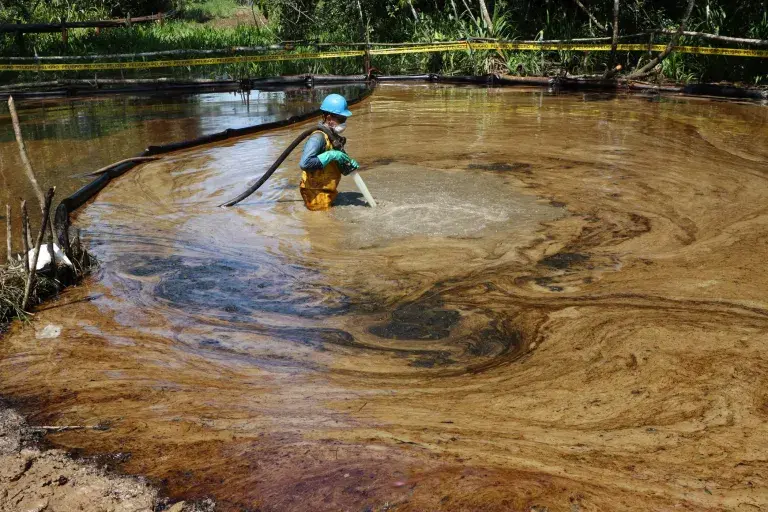
Produced water is not the water of the river through which it travels. It rises from petroleum formations carrying high concentrations of salts and other substances capable of altering the chemistry of freshwater ecosystems. Field observations documented whitish currents, chemical odours, dead fish and vegetation losing colour along the affected waterways. A pink river dolphin and a tapir were also found dead within the wider area of concern. Conductivity readings reached approximately 1,800 to 2,000 microsiemens per centimetre, compared with readings near 160 in unaffected water. The figures gave numerical form to what the river had already begun to reveal.
The contamination moved beyond the point of failure. During June and July, heavy rainfall carried the affected water towards the system of lagoons for which the reserve is internationally known. Communities were warned not to drink from the water or eat fish taken from it. Beneath the surface lay another danger: the possibility that the freshwater aquifer above the intended injection formation had also been affected. Independent sampling and analysis are essential, but uncertainty regarding the full extent of contamination is not a reason to postpone protection. It is precisely the condition in which precaution becomes necessary.
A SELVA field inspection on 17 August found the discharge continuing. More than three months after the original failure, contaminated fluid was still entering the river system. The event could no longer be described merely as the history of a broken well awaiting repair. It had become a continuing violation whose consequences were travelling downstream.
The investigation Environmental Emergency in the Cuyabeno documents the failure, the field evidence and the danger to the reserve and its waters. It also asks whether the remaining economic value of ageing petroleum infrastructure can justify exposing an ecosystem of universal importance to damage that may outlive it.
The investigation establishes what has occurred. The Constitution determines what must now follow.
Articles 71, 72 and 73 recognise Nature’s right to maintain its life cycles, to receive restoration after injury and to be protected before uncertainty becomes irreversible loss. Article 411 requires Ecuador to conserve its water resources, watersheds and ecological flows and to regulate activities capable of affecting water quality, quantity or ecosystem balance. Produced water escaping towards a flooded rainforest does not present an especially obscure constitutional question.
Article 87 provides the immediate route. It permits constitutional precautionary measures to be ordered independently or together with other constitutional actions to prevent or bring an end to the violation or threatened violation of a right. Articles 26 to 33 of the Organic Law on Jurisdictional Guarantees and Constitutional Control establish the corresponding procedure. The law does not require a river to complete its destruction before protection becomes available.
SELVA is therefore instructing its lawyers to seek urgent precautionary measures requiring Petroecuador to end the discharge; mobilise the equipment necessary to repair or isolate the failed system; and provide independently verifiable evidence that the contamination has ceased. Siona representatives and independent specialists should retain access to the affected area, while an appropriate institution appointed by the court supervises compliance, sampling and the measures required for restoration. An assurance issued by the operator responsible for the failure cannot substitute for verification.
A community should not be required to drink the evidence before the State agrees that the danger was real.
The approaching El Niño gives this emergency wider consequence. If Amazonian rivers fall while the rains are delayed, reduced flows will diminish dilution and concentrate contaminants within waters already under stress. Fish, river dolphins, flooded forests and communities will face not an isolated engineering failure, but that failure intensified by heat and drought. El Niño did not rupture the well. It may reveal how much more dangerous a preventable injury becomes when it enters a weakened Amazon.
Cuyabeno presents damage already in motion. Farther west, near Aguarico 3, the Constitution still has an opportunity to arrive first.
Before the Damage Becomes Evidence


Near the community of Bellavista, Gpower proposes to receive, process, store and dispose of industrial, hazardous and hospital waste upon approximately 40 hectares of Amazonian land. The intended site lies among freshwater sources used by surrounding communities, farms and livestock. These are not isolated pools whose contamination could be contained within a property boundary. They form part of the hydrological system of the Aguarico, the principal river of Sucumbíos, which flows into the Napo and ultimately the Amazon. What enters the water at Aguarico 3 may therefore travel considerably farther than the company proposing to manage it—or the country authorising it.
The property directly borders SELVA’s Aguarico Amazon Reserve for Peace, where years of restoration with native rainforest species have strengthened a recovering ecosystem along the same boundary. An operation created to receive contaminated soil, petroleum sludge, used oils, solvents, acids, heavy metals, drilling residues, industrial wastewater and hospital refuse would consequently stand beside community water sources, agricultural livelihoods, restored forest and one of the great freshwater arteries of the upper Amazon. Lines drawn upon a land-use plan may divide ownership. They do not divide the water moving beneath and across it.
The official evidence is unusually clear. After SELVA requested a formal determination from the Municipality of Lago Agrio, the municipal financial authority confirmed that Gpower had neither registered the proposed activity nor received the required municipal patent. The officials responsible for land-use regulation classified the Bellavista property as rural protected land whose principal purpose is the conservation of natural heritage. Gpower’s proposed waste operation was classified as Industrial 4 activity. Its compatibility with the land was recorded in a word that leaves relatively little room for interpretative enthusiasm: prohibited.
That finding would be important even without a precedent. There is one.
At Gpower’s operation in Shushufindi, an investigation documented nine uncovered basins across a property of approximately 39 hectares, surrounded by streams, crops and homes. Residents described chemical odours, trucks arriving at night and flies proliferating around the site. A subsequent municipal inspection found inadequately configured containment barriers, torn ordinary plastic where resistant geomembrane should have been installed, and dark, foaming liquid draining from contaminated-soil treatment areas into a ravine and then a stream. The inspectors concluded that rainfall was carrying polluted material beyond the treatment zones and into surrounding soil and water.
Following an administrative proceeding in which the company was notified and presented its defence, the Municipality of Shushufindi adopted those technical findings and revoked Gpower’s municipal patent and land-use certificate. The paperwork stopped; the contamination had already acquired a current of its own.
Shushufindi is therefore not an incidental accusation against a company. It is the documented precedent through which the foreseeable danger at Aguarico 3 must be judged. Industrial procedures, environmental studies and assurances of secure containment cannot restore a freshwater source after hazardous substances have entered it. Shushufindi has already conducted the experiment. Another part of the Amazon should not be required to reproduce the result.
SELVA is wholly opposed to the Gpower project at Aguarico 3 and is coordinating community, national and international support to prevent it from proceeding. This position does not arise from an indiscriminate objection to the professional management of hazardous waste. It follows from the proposed location, the vulnerability and importance of the surrounding river system, the municipality’s determination that the intended activity is prohibited, and Gpower’s documented environmental record at Shushufindi. Moving toxic material does not remove its danger. It transfers that danger from one place—and often from one community—to another.
Preventing the project will require field observation, hydrological research, laboratory analysis, scientific expertise, legal representation, community coordination and sustained public scrutiny. These are the practical instruments through which precaution becomes more than a constitutional aspiration. They also carry costs that should not fall upon communities already being asked to place their water, health and livelihoods at risk.
This is the narrow interval in which an organisation such as SELVA acquires its importance: after a danger has been identified, but before it has been converted into another environmental emergency. Its task is not to speak in place of Indigenous or rural communities, nor to claim the work of others. It is to remain beside them; help establish what is threatened; bring scientific evidence, constitutional law and local knowledge together; and give prevention the practical means to arrive in time.
The Work of Keeping a Forest Alive
Prevention, however, is not the whole destination. A wounded Amazon must also be given the conditions to recover, while the intact forest that remains must not be sacrificed upon the assumption that money and seedlings can later reproduce it. Primary rainforest is the work of centuries: roots, fungi, insects, birds, mammals, water and soil forming relationships that no restoration budget can recreate on command.
On degraded land, recovery nevertheless remains possible when restoration respects ecological complexity and is allowed sufficient time. SELVA’s Green Diamond method brings groups of native species together so that different forest layers, food sources and ecological functions can progressively return. Endangered hardwoods are planted alongside fruiting trees and other species upon which wildlife depends. As shade deepens and vegetation becomes more varied, insects, birds, monkeys and other animals begin to restore relationships that no plantation of a single commercial species could provide.
This is slow work, which may explain why it rarely commands the attention granted to an oil well, a mine or an industrial installation. Extraction announces itself with investment figures, production targets and promises of immediate employment. A young higuerón offers no comparable presentation. It merely begins the patient business of holding soil, producing fruit, sheltering life and returning water to the atmosphere.
This understanding informs SELVA’s contribution through Time, Continuity, and the Economic Value of Intact Ecosystems—TIES—which draws inspiration from the analysis of “Ecosystem Services in the Ecuadorian Amazon” by Jackson, Dodderlein and Mulyadi and carries it into the practical circumstances of rainforest protection and restoration. This begins from an omission already visible throughout this article: conventional GDP records much of what is removed from nature, but little of the value continuously created by an ecosystem that remains alive.
TIES therefore asks how environmental services can be translated into recognised economic capital, income and productive activity without destroying the natural system that generates them. Research, restoration, sustainable tourism, climate and water services, biological knowledge and locally rooted enterprise can create employment, attract investment and contribute substantially to GDP while leaving the forest standing. Ecological continuity becomes the productive foundation of development rather than an obstacle to it.
This is not an argument for denying Amazonian communities economic opportunity. It is a proposal for creating opportunities whose natural foundation becomes more valuable through time and in which the people protecting that value participate directly in the prosperity it generates. Extractivism has long presented itself as the only practical economy available to the rainforest. TIES offers a serious alternative: one capable of converting the value of a living ecosystem into measurable human benefit without first converting the ecosystem into a memory.
SELVA’s reserves, restoration work, field investigations and constitutional interventions belong to the same proposition. Protecting standing rainforest, helping damaged land recover and preventing contamination are not separate activities. Each defends the living systems through which the Amazon continues to provide water, climatic stability and biological abundance. Support for that work does not purchase an abstraction. It allows observation to continue, samples to be analysed, communities to obtain legal assistance, native trees to be raised and protection to remain present after public attention has moved elsewhere.
What the Dry Season Asks
The approaching El Niño now draws these arguments together. Reduced river flows may diminish dilution and concentrate pollutants within waters already under pressure. Higher temperatures and delayed rainfall may dry vegetation, deepen existing ecological stress and increase the danger of fire. El Niño did not rupture the Cuyabeno well, select the site at Aguarico 3, open an extractive frontier or weaken environmental protection. It will encounter the consequences of those decisions.
Cuyabeno shows the cost of allowing prevention to arrive late. Aguarico 3 asks whether the same constitutional order can act while the danger remains preventable. Restoration shows that some wounds can heal, but also that recovery demands knowledge, continuity and time. Together, they expose the false economy at the centre of environmental destruction: protection is questioned because it carries a visible cost, while the far greater expense of failure is left to rivers, communities and future governments.
The consequences will not remain neatly inside Amazonia. The connection is not that one protected reserve can prevent a fire in Spain, or that a single contaminated stream determines the temperature of a European summer. It is that every further reduction of the Amazon’s capacity to circulate water, store carbon and moderate heat weakens a planetary system upon which climatic resilience elsewhere also depends. A warming world wounds the Amazon; a diminished Amazon leaves that world with less capacity to withstand the warming.
The reader who remembers trees burning in Sierra Norte, the pine forests of Gironde and Landes turning to smoke, parks losing their shade and familiar birds falling silent has already encountered part of the argument. When another heat record is broken, when smoke enters another home or when a river falls below a level once considered extraordinary, the standing Amazon should no longer appear distant. Its continued life forms part of the defence of every person living beneath the same atmosphere.
This is why the choice between Cuyabeno and Aguarico 3 matters beyond two rivers in Ecuador. One carries an injury that must be stopped and restored. The other still offers the possibility that evidence, law and organised action may prevent injury from beginning. Between them lies the choice confronting the wider Amazon: whether humanity will protect environmental services while they continue to function, or rediscover their value through the cost of their disappearance.
Governments will continue to debate development, corporations will continue to present assurances, and political leaders may continue to treat ecological restraint as an obstacle to prosperity. The rivers are unlikely to participate in the discussion. They will carry whatever reaches them. The forest will respond to the heat, the drought and the injuries already inflicted upon it. Its response will be measured not in speeches, but in water, fire, silence and what remains alive.
A rainforest should not fear the dry season. If it now does, the danger lies not only in the El Niño approaching through its trees, but in what humanity has done before its arrival—and in whether protection can still reach the water in time.
El Niño will pass. The decisions made before and during it will not. The rains will return; the question is what will remain alive to receive them.



Comments